

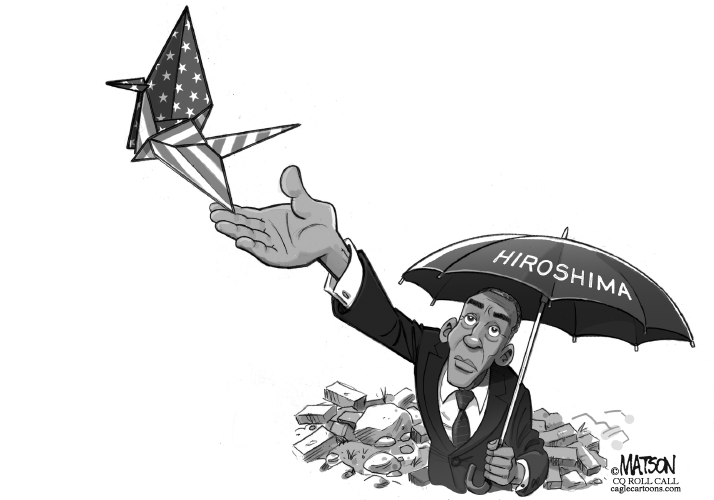
Kyoko Hayashi nearly died on Aug. 9, 1945, in the atomic bombing of Nagasaki. She was 14 years old and working at a factory less than a mile from the epicenter of the atomic explosion. She traveled barefoot for nine hours through the ruins of Nagasaki passing many dead and dying who had been crushed, burned and wounded.
The unique tragedy of those who lost their lives to the bomb, she feels, is that the bomb not only deprived them of their lives but of “their own personal deaths.” And for the survivors like herself, known as hibakusha, “the shortening of a given life, not being able to live fully – this was the promise made between an atomic bomb and its victims.”
The bomb changed time for her. “I could not make an appointment longer than a month ahead,” given that many hibakusha friends died from unpredictable bleeding. “The past is always present and the future is never countable.”
In one of her many published stories, Hayashi invents a new calendar, the “A-bomb calendar,” which designates 1945 as the first year.
Why? “The significance of the birth of Christ or Buddha pales in comparison,” she wrote, with the event that demonstrated that “humans had gained the means to destroy their own species, all other species and the earth.”
Fifty-four years after surviving the bomb, Hayashi journeyed from Japan to the Trinity Site in New Mexico, the location of the first atomic bomb explosion and a national landmark since 1975, which she views as “a hibakusha’s birth place.”
Standing in “Ground Zero” at Trinity Site, she looks out to the red mountains and wilderness beyond and senses a kinship with desert plants and animals. “Until now as I stand at Trinity Site, I have thought it was we humans who were the first atomic bomb victims on Earth. I was wrong. Here are my senior hibakusha. They are here but cannot cry or yell.”
After viewing museum films that lionized the scientists of the atomic bomb project, she writes, “I understand winners create a proud history … [but] the world did not need your experiment.’’ Hayashi’s bitter words echo the stark sentiment expressed by Admiral William Halsey, commander of the Third Fleet, in 1946: “The first atomic bomb was an unnecessary experiment .… It was a mistake to ever drop it.”
And before Congress in 1949, he testified that “bombing – especially atomic bombing – of civilians is morally indefensible.”
Key World War II American military leaders from all branches of the armed forces, among them generals Eisenhower, Arnold, Marshall and MacArthur and Admirals Leahy, Nimitz, and Halsey, strongly dissented from the decision to use the bombs – some before August 1945, some in retrospect – for both military and moral reasons.
In December 1996, retired Air Force General Lee Butler, former commander of the Strategic Air Command that oversaw the nuclear arsenal, used a National Press Club luncheon as a forum to urge his government to take the lead in abolishing nuclear weapons. “Nuclear war,” he held, “is a raging, insatiable beast whose instincts and appetites we pretend to understand but cannot possibly control.”
Nothing, he concluded, not deterrence, not national security, justifies these weapons of physical and genetic terror. And, most recently, William Perry, the respected former defense secretary in the Clinton administration, offered a bleak and chilling assessment: “Today, the danger of some sort of a nuclear catastrophe is greater than it was during the Cold War and most people are blissfully unaware of this danger.”
Only by dumb luck, he adds, have we escaped nuclear war thus far; nuclear weapons endanger national and global security.
Contrast this realist wisdom from military and defense experts with our government’s current nuclear weapons policy. Over the next 30 years, the United States plans to spend $1 trillion to modernize the existing arsenal of nuclear bombs and warheads and their delivery systems by air, land and sea, despite our existing capacity to destroy the world many times over.
We live in a state of widespread public ignorance and public passivity because of government secrecy and denial about the “raging, insatiable beast” of nuclear weapons and because of the immense insider power of the defense industry.
Pick your issue of American insecurity and suffering. It might be 20 percent overall child poverty (38 percent for black children). Or paychecks that working people cannot live on, or costs of education and housing, or climate change, or prison reform or human trafficking. Then imagine how one trillion dollars to modernize nuclear weapons and police the world could be invested in what the majority of Americans need and want.
Frances Crowe of Northampton has been a lifelong activist against nuclear weapons. Pat Hynes has opposed nuclear weapons since she witnessed the effects of the first atomic bomb at the Hiroshima Peace Memorial Museum three decades ago.
On Saturday, a commemoration of Hiroshima and Nagasaki victims will be held at McConnell Hall, Smith College in Northampton at 7 p.m., followed by a floating lantern ceremony at 8 p.m. On Tuesday, a Community Peace Gathering will take place at First Church Amherst from 4:30 to 6 p.m.