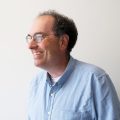
NORTHAMPTON — As a child growing up in a refugee camp in the Palestinian city of Ramallah, Ramzi Aburedwan suffered multiple gunshot wounds while rebelling against the Israeli occupation of the West Bank.
“I’ve been shot three times in my legs, and once in my arm,” said Aburedwan, speaking
More than a quarter century after being a combatant in the ongoing conflict in the Middle East, Aburedwan is a composer and musician who brings his story, and aspirations for peace and freedom through Palestinian music, to audiences around the world.
At 7 p.m. Wednesday, Aburedwan will lead the Dal’ouna Ensemble in a concert at First Churches, 129 Main St.
Aburedwan gained fame when a photograph circulated across the world showing him poised to toss a stone at a Jeep carrying members of the Israeli Defense Forces into the Al Amari refugee camp. Although he was too young to understand the conflict, when the soldiers started shooting guns, Aburedwan was among those who picked up rocks and threw them at those on board.
“We didn’t have any political point of view, it was a matter of protecting ground in the camp,” Aburedwan said.
This sort of violence was something Aburedwan, 36, was surrounded by and to which he became accustomed during the First Intifada uprising against the Israeli soldiers in the late 1980s. But he and others were unaware that such actions, even by the youngest children in the camp, could cost them their lives.
“Every time we were throwing stones we were in danger, but we did not know it at the time,” Aburedwan said.
The camp was supposed to be a temporary place for Palestinian people to stay after Aburedwan’s grandfather was forced to relocate in 1948. Houses were so close together that youths had no choice but to play in the street, he said. They could not leave the camp.
Aburedwan’s life changed when, at the age of 16, he was invited to participate in a musical workshop at the Edward Said National Conservatory of Music in Ramallah in the late 1990s, before studying viola at the National Regional Conservatory of Angers in France.
His musical studies came more by chance than skill. “I always wanted to pursue music as a dream, but it was out of the realm,” Aburedwan said.
In 2000, he formed Dal’ouna, a French-Arabic ensemble, and soon after thought about opening music camps for kids in the refugee camps. Providing children instruments and an opportunity to study music started two years later.
With support from people and private donors, Aburedwan in 2005 created the Al Kamandjati Association, which does formal outreach to the growing number of children in the refugee camps, including at Al Amari, the village of Deir Ghassana, cities like Ramallah and Gaza City, and in Lebanon, Bourj el Barajneh and Shatila.
Coming to Northampton, and other places in the United States during a month-long tour, allows Aburedwan to tell his story.
“I use the stage and my experience to tell people about my dream, and people react by donating instruments they didn’t use or making donations to the schools,” Aburedwan said.
There is a growing need, as refugee camps are much more populated than when he was young, with homes built up three to five floors. “It’s safe, but with more people in the camp, there’s less activity for the kids,” Aburedwan said.
Already, he has seen success of bringing energy and meaning to lives of Palestinian youths, with two now playing in Washington, and others touring in France. “Music gives them this opening to the world,” Aburedwan said.
This is his second tour in the United States. The ensemble includes Moroccan singer Nidal Ibourk, percussionist Tareq Rantisi, oud player Zia Ben Youssef and accordianist Edwin Buger.
Excerpts from “Children of Stone,” a book about Aburedwan’s life written by Sandy Tolan, will be read during the evening and copies sold.
General admission tickets, which are available at the door, are $15, and $10 for students.
Scott Merzbach can be reached at smerzbach@gazettenet.com.